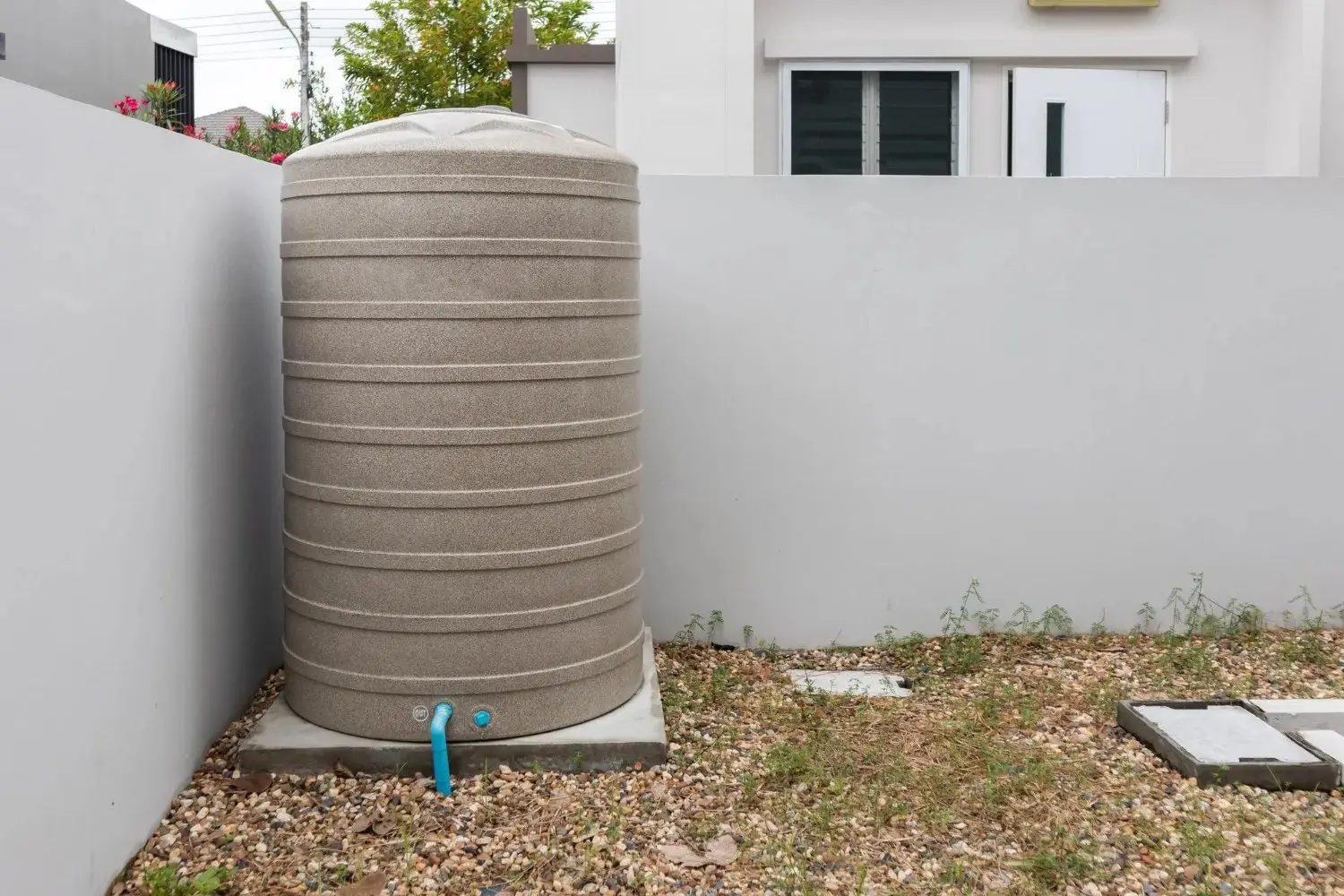
To clean a water tank, switch off the pump, drain the tank, remove the sludge from the floor, wash the inside down with clean water and a soft brush, rinse it, then refill it and disinfect the water with a measured dose of chlorine. Most household tanks only need a full clean when sludge has built up, which is why the standard advice is to inspect a tank every six months and check for sediment every two to three years. Work from outside the tank wherever you can: a tank is a confined space.
The routine below works for the plastic JoJo-style tanks most South African homes use, whether they store municipal water for outages or harvested rainwater.
How often should you clean a water tank?
Australia's national rainwater tank guidance recommends a quick inspection every six months and a check for accumulated sediment every two to three years, or sooner if sediment shows up in the water. If the floor of the tank is covered in sludge, it is time to clean. JoJo's own advice for rainwater tanks is to clean just before the rainy season, when the tank is low anyway. In the Western Cape that means late summer or autumn, before the winter rains.
Signs your tank needs cleaning now
- Grit or sediment at the taps, or filter cartridges that block much faster than they used to.
- A musty or rotten-egg smell, which often points to sludge breaking down on the tank floor.
- Green slime or algae on the walls, which means light is getting in somewhere.
- Mosquito larvae, insects, frogs or a dead animal in the water.
- Dirty water getting in, for example through a cracked lid, a flood or a burst pipe.
- A failed water test. If a sample shows E. coli or coliforms, our guide to what a positive bacteria test means explains how to find the source before you clean.
Before you start: safety and preparation
Do the job from outside the tank. People die in confined spaces because the air inside is short of oxygen or full of fumes, and would-be rescuers often become victims too. If someone genuinely has to go inside a large or underground tank, it needs ventilation and a second person standing by, and is better left to a tank cleaning company.
- Never mix chlorine with other cleaners. Bleach and pool chlorine release toxic chlorine gas when they meet acids or other cleaning products. Wear gloves and eye protection when you handle them.
- Switch off the pump so it cannot run dry, and close the municipal top-up valve on a backup tank or divert the downpipe on a rainwater tank.
- Protect your filters. Chlorine shortens the life of carbon cartridges and can damage reverse osmosis membranes, so check their manuals before you chlorinate; some need bypassing until the chlorine level drops.
- Plan where the water and sludge go. Run rinse water away from the tank base and the house foundations. In Cape Town, the City asks that tank sludge goes to a municipal waste site rather than down the sewer.
How to clean a JoJo tank step by step
- Drain the tank through the outlet or a hose. On most tanks the outlet sits a little above the floor, so expect a layer of water and sludge to stay behind.
- Remove the sludge. Scoop or vacuum it out through the access opening, or flush it out through the outlet with a hose. For small tanks, JoJo's own method is to disconnect the fittings, lay the empty tank on its side with the outlet open and hose it out.
- Wash the walls with clean water and a soft brush or broom on a long handle, working through the lid opening. Plain water does the job; solvents, strong detergents and abrasives can leave tastes or damage the inner surface.
- Rinse and drain again until the water runs clear.
- Service the fittings while the tank is empty: clean the inlet screen, check the lid seal and the overflow mesh, and empty the first flush diverter on a rainwater system.
- Refill and disinfect the water, as described below.
- Check the sediment cartridge after the pump once the system is running again, because cleaning stirs up fine silt.
How to clean a water tank without removing the water
You do not have to empty a tank to get the sludge out, which matters during restrictions or when the tank is your only supply. The Australian guidance describes siphoning it off the floor: fit an inverted funnel to the end of a hose and move it slowly across the bottom, so the sludge and the bottom layer of water run to waste. A wider hose, about 50 mm, copes better with leaves. A suitable pump does the same with very little water lost, and tank cleaning businesses offer desludging too.
This removes what has settled, not slime on the walls. If the walls are coated or the water smells, plan a full clean when the tank is next low.
How much chlorine to add to a water tank
Once the tank is clean and refilled, disinfect the water in it. The aim is a free chlorine residual of at least 0.5 mg/L after 30 minutes of contact, which you can check with an ordinary swimming pool test kit. As a starting point, the Australian guidance gives 40 mL of liquid sodium hypochlorite at 12.5% available chlorine, or 7 g of granular calcium hypochlorite at 75%, per 1 000 litres of water. Both work out at about 5 mg/L.
Household bleach is weaker than pool-grade liquid chlorine, so you need more. Use plain, unscented bleach and read the label: 3.5% sodium hypochlorite is a common household strength in South Africa, but some multipurpose bleach cleaners are weaker. Do not use stabilised pool chlorine, which does not work in enclosed tanks.
| Water in the tank | Liquid chlorine, 12.5% | Household bleach, 3.5% | Granular calcium hypochlorite, 75% |
|---|---|---|---|
| 1 000 L | 40 mL | about 150 mL | 7 g |
| 2 500 L | 100 mL | about 375 mL | about 18 g |
| 5 000 L | 200 mL | about 750 mL | 35 g |
| 10 000 L | 400 mL | about 1.5 L | 70 g |
The amounts are for the litres of water actually in the tank, not its rated size. Dissolve granular chlorine in a bucket of water outdoors first, and always add the chemical to water, never water to the chemical. Spread it across the surface, then leave it to stand for at least an hour before use. Dirty water uses up chlorine, and bleach loses strength as it ages, so if the test kit shows less than 0.5 mg/L after 30 minutes, add a little more. The chlorine taste fades over one to two weeks.
Keeping stored water clean between cleans
Keep out light, dirt and animals
Algae need light, so green growth means light is getting in through a gap, a missing cap or a cracked lid. JoJo tanks have a black inner layer to block light, and shade keeps the water cooler too. Fit insect-proof mesh, no coarser than 1 mm, over the inlet and overflow, and keep the lid closed and clipped down. Mosquito larvae in a tank mean there is an opening that needs sealing.
Backup tanks: keep the water moving
Municipal water carries a small chlorine residual that protects it in the pipes. That residual fades as water stands, and long storage, warm weather and the loss of chlorine let bacteria regrow in household tanks. Our guide to water quality in South Africa explains why Cape Town tap water is safe at the tap; the aim with a backup tank is to keep it that way. Where you can, plumb the tank so mains water flows through it in normal use, rather than sitting until the next outage. The water tank size calculator shows how long common tank sizes last. If a tank also takes rainwater or borehole water and is plumbed into the house, the City of Cape Town requires a reduced pressure zone (RPZ) backflow preventer or an air gap, so tank water can never flow back into the municipal supply.
Filter what comes out of the tank
However clean the tank, the water still picks up fine sediment, so a sediment filter after the pump protects taps, the geyser and any later stages. Borehole water pumped into a tank often carries dissolved iron and manganese that settle out as brown or black deposits; treating it before it reaches the tank, as our borehole water filtration page describes, leaves far less to clean out. If you plan to drink tank water, it also needs a disinfection stage, usually a UV steriliser after the sediment and carbon stages, and a laboratory test against SANS 241. For rainwater and borehole water inside the City of Cape Town, check with the City first before you use it for drinking, cooking or washing; elsewhere, check your municipality's by-laws. Our rainwater filtration guide covers the screens, gutters and full treatment train.
Test the water after you clean
Cleaning and chlorinating reset a tank, but they do not prove the water is safe to drink. If the tank supplies drinking water, take a sample once the chlorine has gone, roughly 10 to 14 days later, so leftover chlorine does not mask bacteria that will come back. Ask the laboratory for E. coli and total coliforms at minimum, and the fuller SANS 241 panel for borehole water. If bacteria return after a clean, look for the way in: an open lid, a gap in the mesh, a dirty roof or a leaking pipe.
Frequently asked questions
How long can you keep water in a JoJo tank?
There is no fixed shelf life: it depends on how clean the tank and water were, how warm it gets and whether light or dirt can get in. For drinking water you have stored yourself, the usual public health advice is to replace it about every six months. For a plumbed backup tank, the better answer is to let mains water flow through it so it never stands for months.
Can you drink water from a JoJo tank?
Municipal water stored for a short time in a clean, sealed tank is generally fine, but it loses its chlorine protection as it stands, so long-stored water should be treated or used for other purposes. Rainwater and borehole water need filtration, disinfection and a test before drinking. Inside the City of Cape Town, check with the City first; elsewhere, check your municipality's by-laws.
How much bleach do I add to a 2 500 litre JoJo tank?
For 2 500 litres of water, about 375 mL of plain household bleach at 3.5% sodium hypochlorite, or 100 mL of 12.5% liquid chlorine, gives roughly 5 mg/L. Check the strength on the label, use an unscented product and confirm with a pool test kit that at least 0.5 mg/L of free chlorine remains after 30 minutes.
If your tank feeds the house, look at the whole system at once: the pump, a sediment filter after it and, if anyone drinks the water, carbon and UV stages sized to your flow. Our home water filtration page explains how those systems fit together. Send us your water source, tank size and area through the quote form and we will suggest what your setup needs.