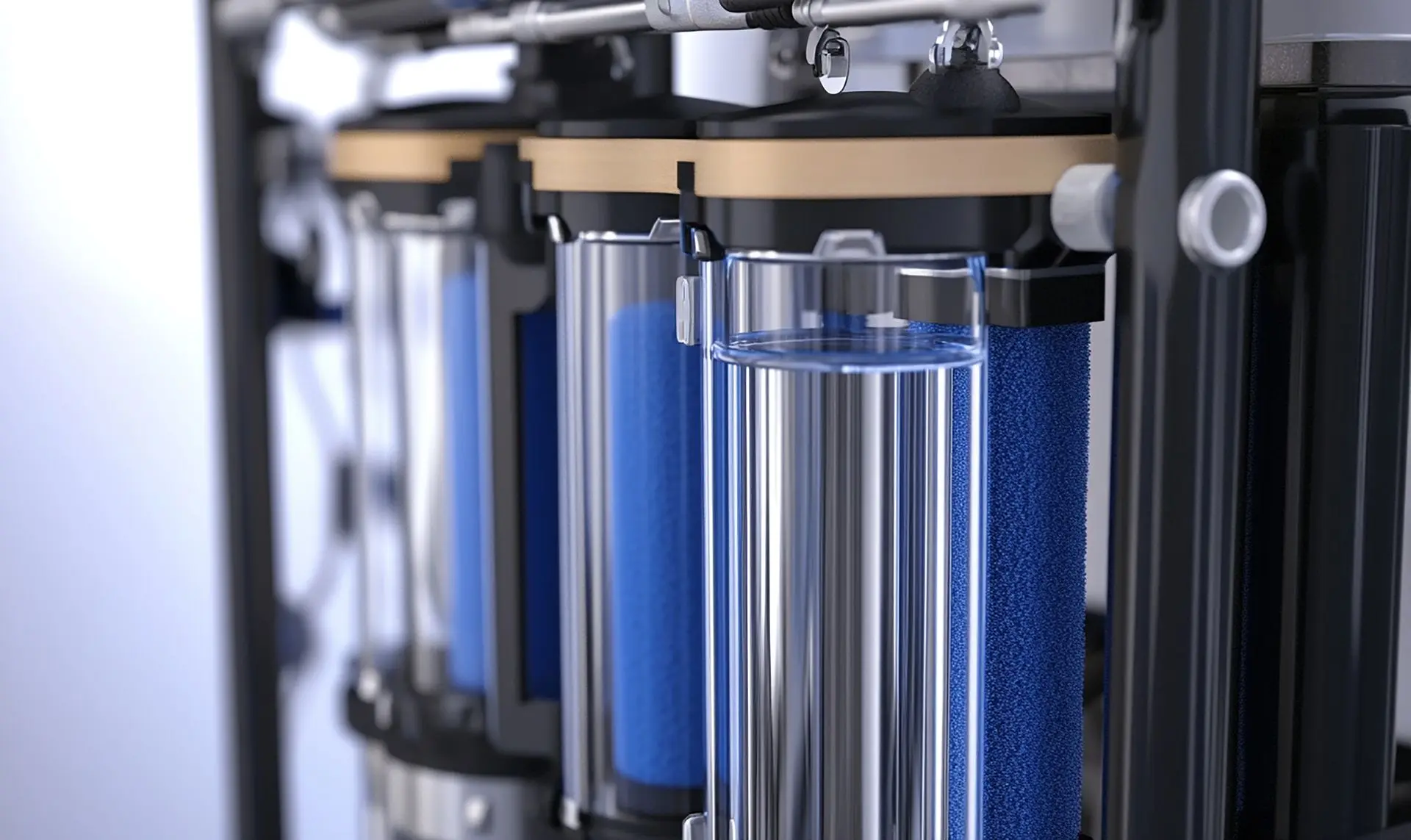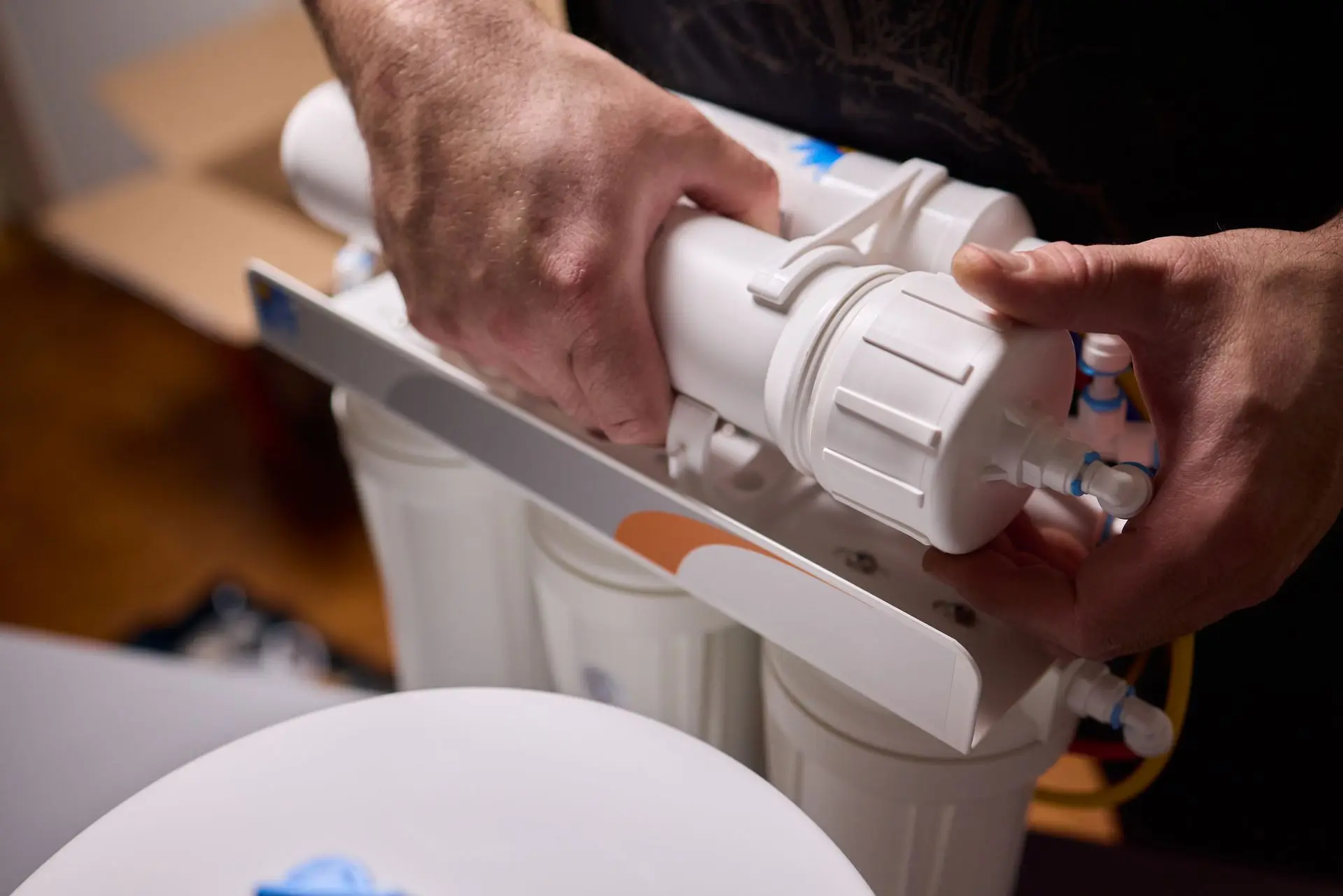
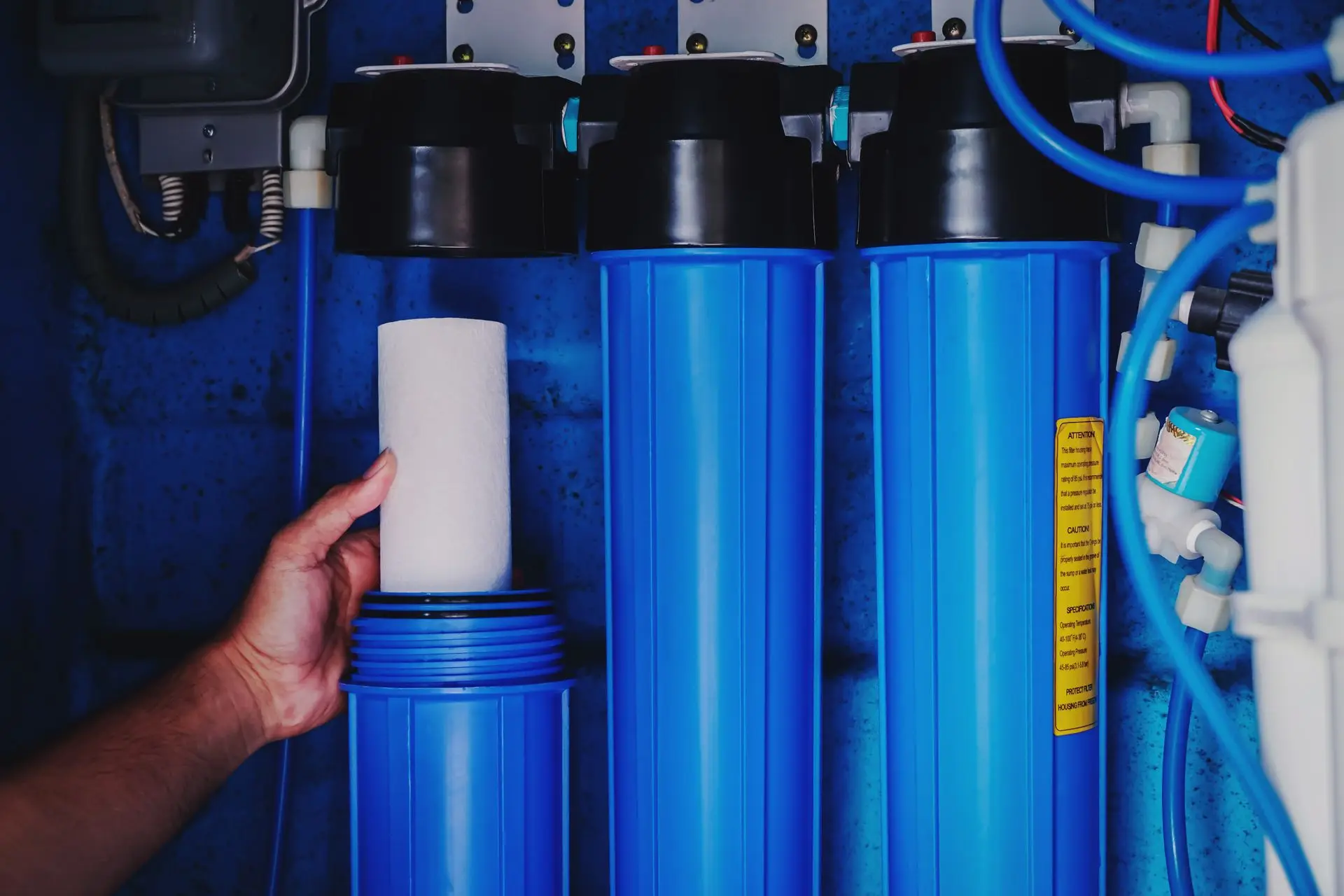
A 3-stage water filter is three cartridge housings plumbed in a row, loaded from coarse to fine: a sediment cartridge first, then carbon, then a finer polishing cartridge such as a carbon block or a 1 micron sediment cartridge. Sediment goes first so that sand and rust do not clog the carbon, and the carbon removes the chlorine taste and smell. On borehole or tank water used for drinking, the set is only pre-treatment and needs UV after it, and often iron removal before it.
What a 3-stage water filter is
A typical 3-stage set is three plastic housings, or sumps, screwed into caps on a shared bracket. Water enters one end and leaves the other, and each cap is marked with the flow direction, usually IN and OUT or an arrow. Fitted where the supply enters the property, the set treats every tap, the shower and the geyser; a slimline version under the sink treats one drinking tap.
"Big Blue" began as a trade name for one manufacturer's 4.5-inch housings, but it is now used for any housing of that size, much as "JoJo" is used for any plastic tank. The housings are made for cold water. One large manufacturer rates its Big Blue housings at 4.4°C to 37.8°C and a maximum of 6.2 to 6.9 bar, and warns that freezing can crack them, so a 3-stage set belongs on the cold supply before the geyser, never on the hot side. Another maker recommends replacing plastic housing bottoms every ten years, so date them when fitted.
The right cartridge order, and why it matters
Each stage should protect the one after it. The usual order is:
- Stage 1, sediment. A spun or pleated polypropylene cartridge, typically 20 or 5 micron, catches sand, silt and rust flakes. It takes the dirt so that the finer stages last longer.
- Stage 2, carbon. Activated carbon adsorbs chlorine and many of the compounds behind bad tastes and smells. Granular carbon (loose granules) allows more flow with less pressure loss; a carbon block (powdered carbon bonded into a solid tube) filters more finely, some to 0.5 micron nominal, but costs more pressure.
- Stage 3, polishing. A finer carbon block, or a 1 or 5 micron sediment cartridge, catches what the first two let through.
Get the order wrong and the system works against itself. A carbon block in the first housing clogs quickly with silt, and a 1 micron cartridge with nothing coarser in front of it does the same. On sandy borehole water, a 50 micron cartridge for coarse sand and scale can go ahead of the 5 micron stage so that it is not changed constantly. For the wider picture, see our guide to how water filtration systems work.
| Water source | Stage 1 | Stage 2 | Stage 3 | Usually also needed |
|---|---|---|---|---|
| Municipal water | 5 micron sediment | Granular carbon or carbon block | Carbon block | Nothing more for taste and smell |
| Borehole water | 20 or 50 micron sediment | 5 micron sediment | Carbon block | Iron removal before the set if the test shows iron; UV after it for drinking |
| Rainwater tank | 20 micron sediment | 5 micron sediment | Carbon block | UV after it for drinking |
Treat the table as a starting point: the water test, the flow the house needs and the dirt load all change the right combination.
Micron ratings explained
A micron is a thousandth of a millimetre. For scale, a human hair is about 70 microns across, and particles smaller than about 40 microns cannot be seen with the naked eye, so a 5 micron cartridge is catching dirt you would never spot in a glass.
The number on a household cartridge is almost always a nominal rating. Under the Water Quality Association's definitions, nominal means roughly 85% of particles at the stated size are caught, while absolute means essentially all of them, about 99.9%. Manufacturers test differently, so two "5 micron" cartridges are not always equal, and most homes do not need absolute-rated ones.
Finer is not automatically better. The smaller the rating, the faster a cartridge loads up and the sooner the pressure drops, so the first stage should suit the supply. A 5 micron cartridge is the standard choice for municipal water and the usual last particle stage before UV, where it stops particles shielding bacteria from the light. Our sediment water filters page explains how the first stage is matched to the supply.
Sizes: 10-inch or 20-inch, slimline or Big Blue
Cartridges come in two families, and they are not interchangeable:
- Slimline (standard) cartridges are about 2.5 inches, or 60 to 73 mm, across and come in 10-inch and 20-inch lengths. A "10-inch" cartridge is actually a little under 10 inches long, at about 248 to 251 mm.
- Big Blue (jumbo) cartridges are about 4.5 inches, or roughly 114 to 118 mm, across. They also come in 10-inch and 20-inch lengths and fit the larger whole-house housings, whose caps have 3/4-inch, 1-inch or 1.5-inch threaded ports.
A slimline cartridge will not seal in a Big Blue sump, and a 20-inch cartridge will not fit a 10-inch housing. Before you buy, measure the old cartridge's length and diameter, or take a photo of the housing and the old cartridge. Our water filter cartridges page covers matching a replacement to the housing you already have.
In a 3-stage set the carbon usually limits the flow, not the housing. One manufacturer's data shows its 1-inch Big Blue housing passing 57 litres a minute with a pressure loss of about 0.07 bar, while its 20-inch Big Blue carbon block is rated for chlorine reduction at about 15 litres a minute. The maker notes that performance depends on flow rate, which is why we size housings, micron ratings and flow rates together on whole-house jobs, so that the pressure holds up when the house is busy.
When to change the cartridges
Change a cartridge when it shows the signs, or when the calendar says so, whichever comes first:
- Falling pressure or flow at the taps, especially the shower. A loaded sediment cartridge is the usual cause. On sets with gauges either side, a widening gap between the readings is the clearest warning.
- A dark or orange sediment cartridge. The pressure, not the colour, tells you when it is full.
- A chlorine taste or smell coming back, which means the carbon is spent. Carbon can be spent before you taste anything, so do not wait for it.
As a rough guide, carbon is changed every six to twelve months. Borehole and tank water usually need more frequent changes than municipal water, especially for the first stage. Write the date on each housing when you change it. Retail cartridge prices and running costs are covered in our water filter cost guide.
How to change 3-stage filter cartridges
Changing cartridges is a simple job once you have the housing spanner that came with the set. These steps follow typical manufacturer instructions; check yours as well.
- Turn off the water to the filter, or switch it to bypass. If that cuts the water to the whole house, fill a bucket first so you can wash the housings.
- Press the pressure-relief button on top of each cap to let the pressure out.
- Unscrew each sump with the spanner, with a bucket underneath.
- Take out the large O-ring and wipe it clean, then throw away the old cartridge.
- Wash each sump. Rinse it, fill it about a third full with water, add about two tablespoons of household bleach, scrub the sump and cap with a non-abrasive sponge, then rinse thoroughly.
- Lightly coat the O-ring with clean, food-grade silicone grease and press it back into its groove.
- Fit each new cartridge over the centre post of the right housing, in the order above.
- Screw the sumps back on hand-tight. The O-ring makes the seal, not force, so do not over-tighten with the spanner.
- Open the water slowly, press the relief buttons to let trapped air out, and check every joint for drips.
- Flush new carbon, which sheds fine black dust at first, before drinking the water. One maker says to run it for 10 minutes, wait an hour, then run it for another 10.
When a 3-stage filter is not enough
Sediment and carbon cartridges do not disinfect water, and a carbon cartridge left in too long or standing idle can grow bacteria of its own. Cartridge makers print a warning on their data sheets not to use them on water that is microbiologically unsafe or of unknown quality without adequate disinfection before or after the system. For borehole, wellpoint and tank water that will be drunk, the usual answer is a UV water filter after the 3-stage set, fed with clear water. UV manufacturers ask for a 5 micron pre-filter and turbidity below 1 NTU, and recommend iron below 0.3 mg/L and hardness below 120 mg/L so that the quartz sleeve does not foul.
Carbon also does not remove hardness, nitrate or fluoride, and cartridges certified to NSF/ANSI 42 are tested for aesthetic claims such as chlorine taste, not health contaminants. White scale on taps and kettles needs a different answer, explained in our guide to hard water in South Africa. Dissolved iron and manganese pass straight through sediment cartridges and then turn into orange or black particles that clog the finer stages and coat UV sleeves, so they need an oxidation or media stage first. Dissolved salts and nitrate need reverse osmosis or another dedicated process. A laboratory test against SANS 241 shows which of these you are dealing with, and our borehole water treatment guide walks through the full sequence from test to UV. For a system designed around your own results, see borehole water filtration.
If you plan to drink treated borehole, wellpoint or rainwater, check with the City first if you are inside the City of Cape Town; elsewhere, check your municipality's by-laws.
Frequently asked questions
What order do the cartridges go in a 3-stage water filter?
Coarse to fine, following the arrow or IN marking on the caps: sediment first, then carbon, then a finer polishing cartridge such as a carbon block or a 1 micron sediment cartridge. If a UV unit is fitted, it comes after all three.
Is a 5 micron sediment filter good?
Yes, for most homes. It is the standard first stage on municipal water and the usual pre-filter before UV. On sandy borehole water, put a 20 or 50 micron cartridge ahead of it so that it does not clog quickly.
How often should 3-stage filter cartridges be changed?
Change sediment cartridges when the pressure drops or they are heavily discoloured, and carbon every six to twelve months, or sooner if the chlorine taste returns. Borehole and tank water usually need more frequent changes than municipal water.
Does a 3-stage water filter remove bacteria?
No. Sediment and carbon cartridges are not designed to disinfect. Where bacteria are a risk, as with borehole or tank water, test the water and fit UV after the set.
If you have a 3-stage set and are not sure what is in it, or you are planning one for the whole house, start with our home water filtration options. Then send us your water source, property type and area with a photo of the housings, and we will suggest the cartridges and change schedule that suit your water.