Borehole water treatment works as a sequence: test the water against SANS 241, take out sediment, remove iron and manganese, soften or polish only where the results call for it, and finish with UV or chlorine disinfection if the water will be drunk. Each stage protects the one after it, so the order matters as much as the equipment.
This guide shows how to purify borehole water once you know it needs treating. If you are still deciding whether yours is fit to drink, start with our guide on whether borehole water is safe to drink, which also covers registration and signage.
Step 1: Test the water and check the site
A laboratory test against SANS 241, the South African drinking water standard, shows which stages you need and which you can skip. It should cover:
- E. coli and total coliforms. SANS 241 allows no E. coli in a 100 mL sample.
- Iron and manganese. Above the aesthetic limits of 0.3 mg/L for iron and 0.1 mg/L for manganese, expect staining and a metallic taste.
- pH, hardness and TDS. These steer the iron, softening and RO decisions.
- Nitrate and fluoride. The health limits are 11 mg/L for nitrate (measured as nitrogen) and 1.5 mg/L for fluoride.
- Turbidity. Cloudy water shields bacteria from both UV and chlorine.
Use a SANAS-accredited laboratory and sample from a tap before any existing filter, following the lab's instructions for the bacteria bottle.
Then check the site: the pump's flow rate and pressure, storage tanks and booster pumps, where the water goes, a drain for backwash water, power for UV and space to change cartridges. Septic tanks, French drains, livestock or fertilised land near the borehole are the usual sources of bacteria and nitrate.
Step 2: Sediment first, to protect the pressure system
Sand and silt wear valves, jam pressure switches, settle in pressure tanks and geysers, and block every finer filter downstream, so a sediment filter always goes first.
Stage the micron ratings. Borehole water usually starts with a coarse cartridge of about 20 to 50 microns, with a finer 1 to 5 micron stage just ahead of carbon, UV or RO. A fine cartridge on its own can block within weeks on a sandy supply. Gauges on either side of the housings show when a cartridge is loading up, and housings sized to the pump's flow, not a single tap, lose less pressure and last longer.
A filter after the pump cannot protect the pump itself, though. A borehole that delivers a lot of sand needs a borehole contractor, not more cartridges.
Step 3: Remove iron and manganese before the fine stages
Iron in borehole water is a well-documented problem in parts of the Western Cape, including the Table Mountain Group sandstone aquifers, Malmesbury Group rocks and the sandy Cape Flats and Atlantis aquifers. Table Mountain Group water also tends to be soft and acidic, which limits the iron options.
Why iron clogs cartridges and fouls UV
Iron often leaves the ground dissolved, so the water looks clear. Once it meets air or chlorine, or sits in a pressure tank, it oxidises into fine rust particles that block sediment and carbon cartridges far sooner than sand would. It also coats the quartz sleeve around a UV lamp, so the lamp keeps glowing while disinfecting less. Manganese does the same, with black deposits. Water reaching a UV unit should generally carry less than 0.3 mg/L of iron and 0.05 mg/L of manganese, unless the manufacturer specifies otherwise.
Three ways to remove iron
- Aeration. Air oxidises the iron and a filter catches the particles. It also strips out some hydrogen sulphide, but manganese oxidises far more slowly and often gets through.
- Chlorine dosing. A dosing pump adds chlorine, which oxidises iron, manganese and hydrogen sulphide quickly and disinfects too. It needs a retention tank for contact time, a filter after it and carbon to remove leftover chlorine. It suits higher iron levels.
- Oxidising media. Birm needs no chemicals but relies on dissolved oxygen in the water, a pH of about 6.8 or higher and no hydrogen sulphide. Greensand-type media handle manganese better but are regenerated with potassium permanganate or a chlorine feed.
Media filters backwash on a timer, often at night, flushing trapped iron to drain. That needs a drain point and enough pump flow to lift the bed, so a low-yield borehole may need a tank and booster pump first. Acidic water can stop some media working and corrodes copper pipes (blue-green stains are the giveaway), so a calcite neutralising stage often goes in first, adding a little hardness as it raises the pH.
Orange slime in toilet cisterns points to iron bacteria, which are not usually a health risk but clog pipes and filters. Control starts with a borehole contractor shock chlorinating the borehole.
Step 4: Soften and polish, if the test justifies it
Is a water softener worth it?
Hardness (calcium and magnesium) causes scale, not illness, and SANS 241 sets no limit for it. A water softener earns its place when the test shows genuinely hard water and scale is costing you geyser elements, appliances or UV performance; UV guidance suggests keeping hardness below about 120 mg/L. Fit it after iron removal, because oxidised iron fouls the resin. Softening adds a little sodium, so many homes keep the kitchen drinking tap unsoftened.
Carbon for taste and the rotten egg smell
Activated carbon is the polishing stage, removing many of the organic compounds behind earthy or musty tastes, plus leftover chlorine after dosing. Carbon water filters sit after the sediment and iron stages so particles do not clog them.
A rotten egg smell is hydrogen sulphide, made by bacteria in low-oxygen groundwater. If only the hot water smells, suspect the geyser's magnesium anode before the borehole. Low levels respond to carbon, while stronger smells need aeration or chlorine followed by filtration, and should be dealt with before birm-type media.
Step 5: Disinfect drinking water with UV or chlorine
UV as the final stage
Borehole water purification for drinking usually ends with ultraviolet light, which inactivates bacteria, viruses and protozoa without adding anything to the water. UV water filters need clear water: particles shade microbes from the light, and iron, manganese and hardness coat the sleeve. Turbidity going in should be below 1 NTU.
Size the unit to the highest flow it will see, since more flow means a lower dose, and for drinking water choose one rated for disinfection, such as NSF/ANSI 55 Class A (40 mJ/cm²). Plan for power cuts with a UPS or a valve that stops the flow when the lamp is off. UV leaves no residual, so if treated water sits in a JoJo tank, bacteria can regrow; fit the UV after the tank.
Chlorine dosing and HTH: the basics
Chlorine is the most widely used of the borehole water treatment chemicals. Unlike UV, it leaves a residual that keeps protecting stored water, which suits tanks and larger systems. It is dosed by a metering pump as liquid sodium hypochlorite, or made up from calcium hypochlorite granules, often called HTH.
There is no universal dose, because iron, manganese, hydrogen sulphide and organic matter use up chlorine before any is left to disinfect. What you measure is the free chlorine remaining. WHO guidance for effective disinfection is at least 0.5 mg/L after 30 minutes' contact at a pH below 8, and SANS 241 caps free chlorine at 5 mg/L. A DPD test kit reads it.
Handle HTH with respect. It is a strong oxidiser that releases toxic chlorine gas on contact with acids and can start fires with oils and other organic material. Keep it dry, sealed and away from other pool chemicals, never mix chemicals, use a product intended for drinking water, and have the dosing set up and checked by someone who can test the result.
Step 6: Treat the whole house or just the kitchen tap
Not every litre needs drinking-water treatment. A cost-sensible design treats the whole supply for what damages plumbing and fittings (sediment, iron, manganese and, where justified, hardness), then polishes only the drinking water at the kitchen tap with carbon and UV, or RO. Drinking and cooking use a small share of household water, so point-of-use stages are smaller and cheaper to run. Our guide to water filter installation costs in South Africa explains what drives the price of each approach.
The exception is bacteria. If the test finds E. coli, water for brushing teeth, washing food and bathing children matters too, so disinfecting the whole supply usually makes sense. Check the local rules before plumbing treated borehole water to drinking taps: inside the City of Cape Town, confirm the by-law position with the City, and elsewhere check your municipality's by-laws.
When reverse osmosis earns its place
Sediment, carbon and UV do not remove dissolved salts. If the test shows TDS above 1 200 mg/L (the SANS 241 aesthetic limit), nitrate above its health limit or fluoride above 1.5 mg/L, reverse osmosis at the kitchen tap is the practical fix.
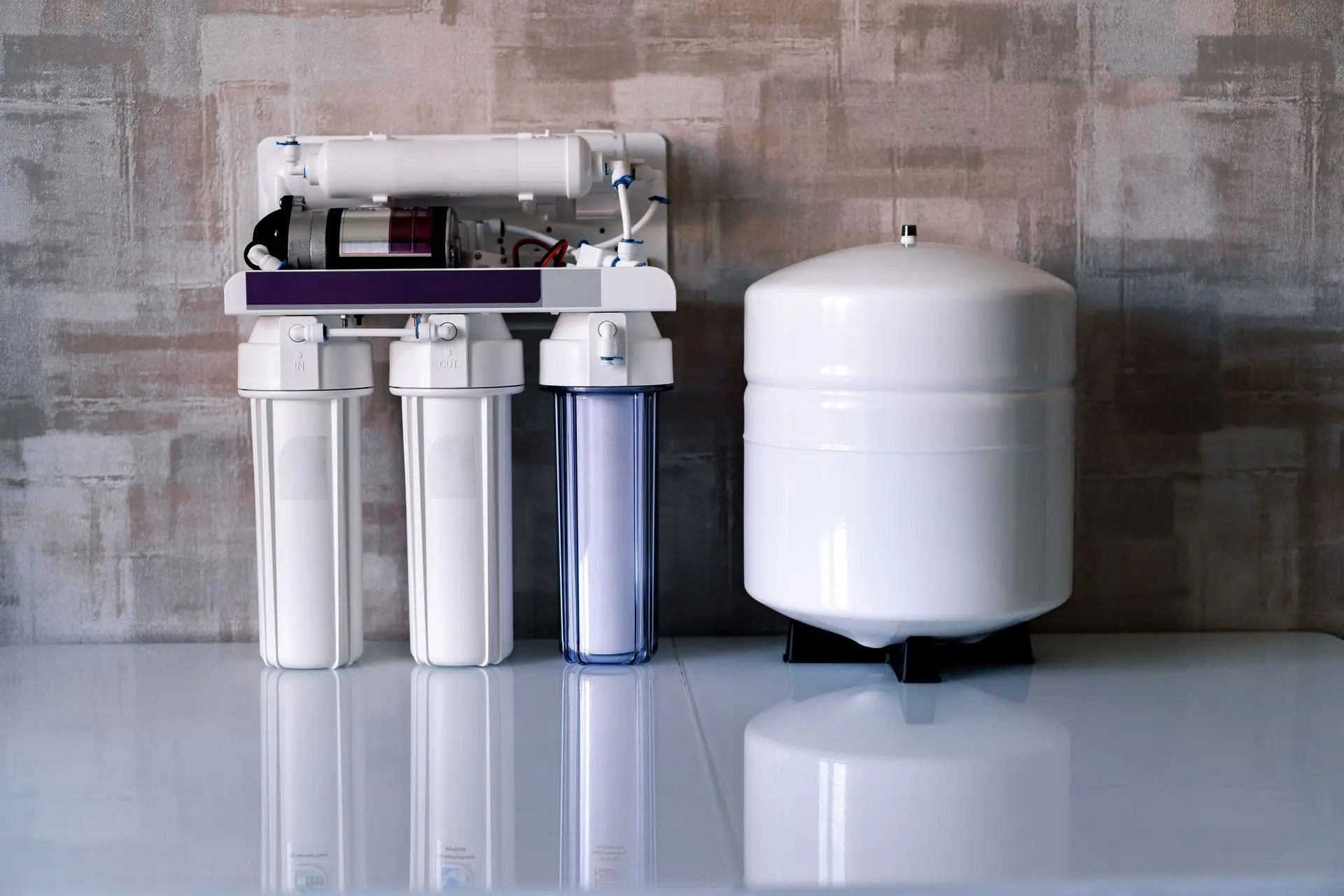
Iron and hardness foul an RO membrane and chlorine damages it, so the whole-house stages and a carbon pre-filter come first. Household RO units also generally carry a warning against use on microbiologically unsafe water without disinfection, so on a borehole RO works alongside UV, not instead of it.
Step 7: Maintain the system and keep testing
Typical intervals, which will shift with your water and usage:
| Stage | Typical service |
|---|---|
| Sediment | Replace when the pressure drop rises |
| Iron media | Check the backwash timer, drain and valve periodically |
| Softener | Top up salt before it runs out |
| Carbon | Replace every 6-12 months, sooner if the taste returns |
| UV | Replace the lamp yearly and clean the sleeve, more often on iron or hard water |
| Chlorine dosing | Refill and check free chlorine regularly |
| Reverse osmosis | Pre-filters every 6-12 months, membrane every 2-3 years |
Retest once the system is running, then at least once a year for bacteria, nitrate, TDS and pH, the baseline the US CDC recommends for private wells. Test again after flooding, after work on the pump or borehole, if the taste, colour or smell changes, or when someone in the house is pregnant or a baby arrives. If the water is used for infant formula, check nitrate first and speak to a doctor or clinic if it is high.
Frequently asked questions
What chemicals are used to treat borehole water?
Mainly chlorine, as sodium hypochlorite or calcium hypochlorite (HTH), to disinfect and to oxidise iron, manganese and hydrogen sulphide. Potassium permanganate regenerates greensand-type media, and calcite or soda ash corrects low pH.
Does boiling borehole water make it safe to drink?
Boiling kills bacteria and viruses but does nothing for iron, nitrate, fluoride or dissolved salts. The WHO notes that prolonged boiling concentrates nitrate, so heat only to a rolling boil. It is an emergency measure, not a treatment system.
How long before treated borehole water is safe to drink?
Not until a lab test on the treated water says so. After a borehole is shock chlorinated, the usual guidance is to retest one to two weeks later and use another drinking water source until the result is clear.
If you have a test result, or know you need one, see how we approach borehole water filtration, then request a quote with your water source, property type and area.