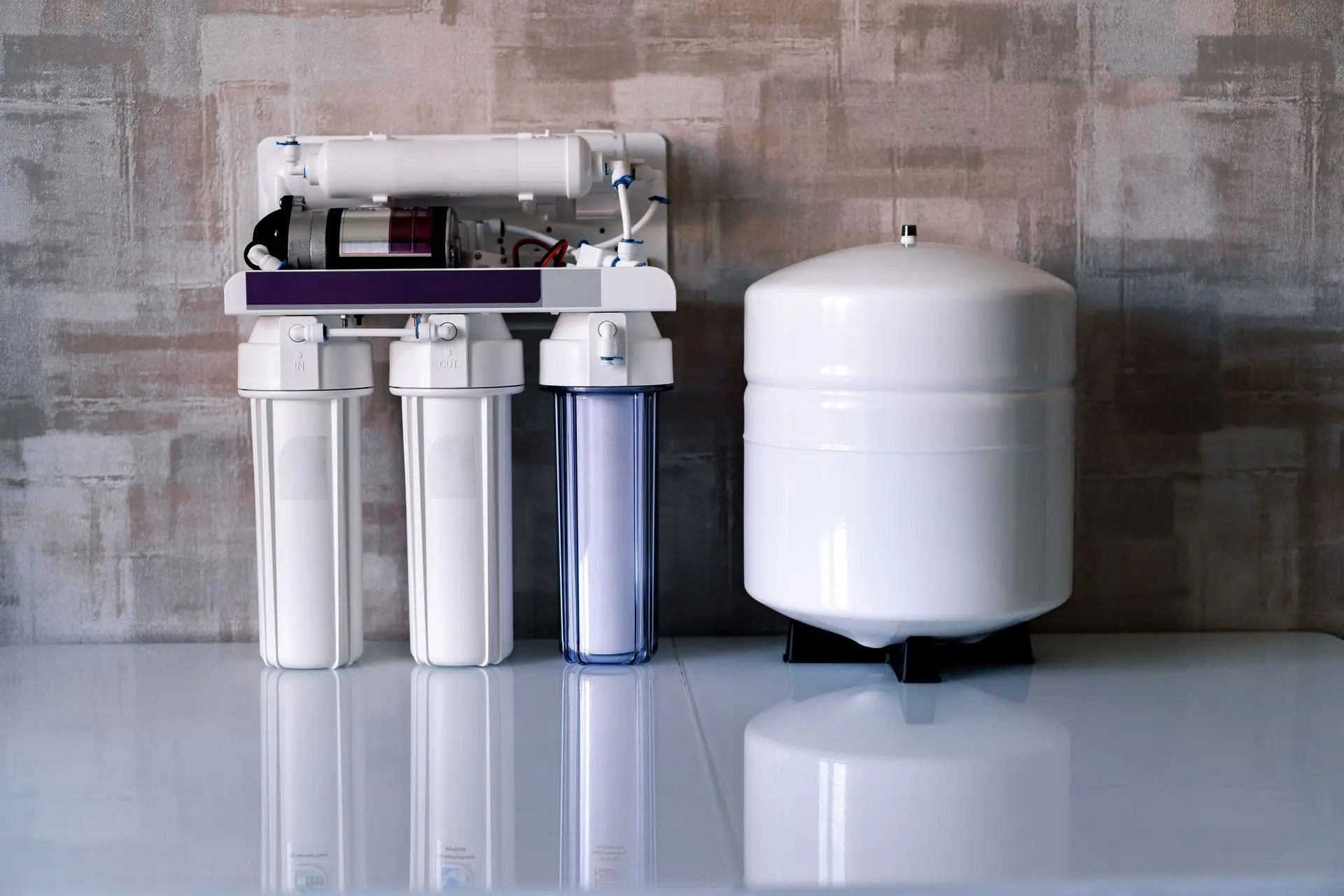
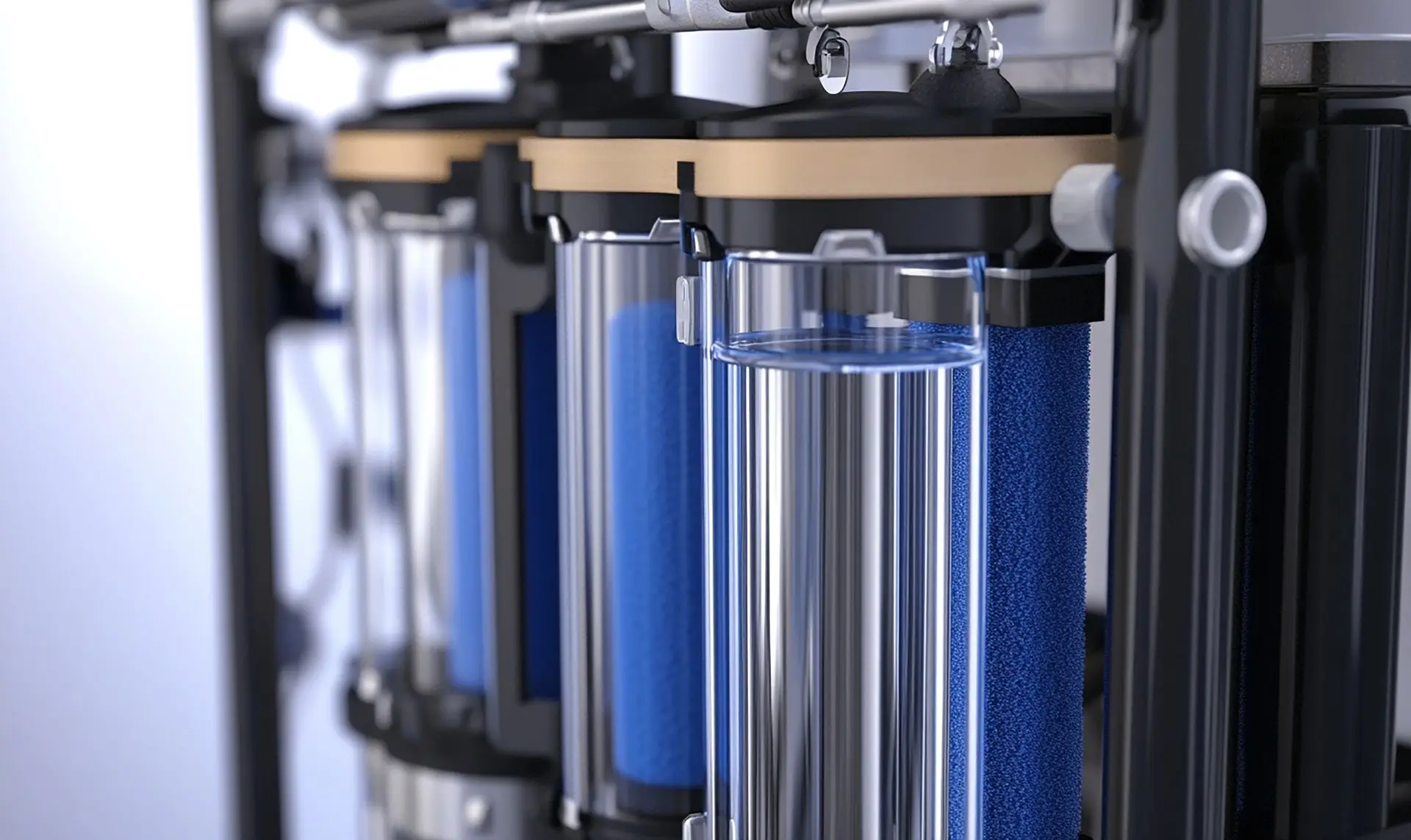
A water filtration system passes water through a series of stages, each built for one job: sediment filters strain out particles, activated carbon adsorbs chlorine and the compounds behind bad tastes and smells, and reverse osmosis or UV deal with dissolved salts or microorganisms. No single filter removes everything, so a system combines stages matched to the water and fitted in a deliberate order.
Why water filtration systems use stages
"Filtration" covers several different processes: straining, adsorption, ion exchange, membrane separation and disinfection. Each works on a particular type of contaminant and does very little for the rest. It helps to think of four groups:
- Particles such as sand, silt and rust, which make water cloudy or gritty.
- Chlorine and organic compounds, which affect taste and smell.
- Dissolved substances such as hardness minerals, salts, iron, manganese and nitrate, which you usually cannot see.
- Microorganisms such as bacteria, viruses and protozoa.
A sediment cartridge cannot touch dissolved salts, and a carbon filter will not make contaminated borehole water safe to drink. Staging lets each filter do one job and lets coarse stages protect finer, more expensive ones. Which groups you need to treat depends on the source, as our guide to water quality in South Africa explains.
How do water filters work? The main technologies
Sediment filters: mechanical straining
A sediment filter is a physical barrier, usually a spun, pleated or string-wound cartridge, that traps particles larger than its rating. Ratings are in microns (a thousandth of a millimetre): coarse cartridges for dirty borehole or tank water, finer ones ahead of carbon, UV or reverse osmosis. Check whether a rating is nominal or absolute. The Water Quality Association defines nominal as about 85% removal at the stated size and absolute as essentially 99.9%, though manufacturers do not all rate the same way. Sediment filters remove nothing dissolved and are not a barrier against bacteria. Our sediment water filters page explains how ratings are matched to a supply.
Activated carbon: adsorption
Activated carbon has a huge internal surface area. Chlorine and many organic compounds stick to that surface as water flows through, a process called adsorption, which makes carbon the taste and odour stage in almost every drinking-water system. Granular activated carbon (GAC) allows higher flow rates, while carbon block is bonded into a solid that filters more finely and suits drinking-water taps. Carbon does not remove bacteria, viruses, hardness, nitrate, fluoride or dissolved salts, and once its surface is full it stops working, so carbon water filters are replaced on a schedule rather than when they look dirty.
Ion exchange: water softening
A softener passes water through resin beads loaded with sodium, which swap that sodium for the calcium and magnesium that cause scale. When the resin is full, it regenerates by flushing with salt brine. Softening protects geysers and appliances on hard water but does not remove particles, chlorine or microorganisms. Specialist resins use the same principle to target other substances, nitrate being the usual example.
Oxidation and iron-removal media
Iron and manganese are common in borehole water and are often dissolved, so the water leaves the pump clear and then forms orange-brown or black deposits once it meets air. Dissolved iron passes straight through a sediment filter. Iron-removal systems first oxidise it, using media such as manganese greensand or birm, air or a dosed oxidant, so it becomes particles the media bed can trap and backwash away. The right method depends on iron and manganese levels and pH, so it is chosen from a laboratory test.
Reverse osmosis: membrane separation
Reverse osmosis (RO) uses water pressure to push water through a semi-permeable membrane that most dissolved substances cannot pass, reducing salts, nitrate, fluoride and many metals such as lead and arsenic. Rejected impurities go to drain with waste water, and the US EPA puts a typical point-of-use unit at five or more litres to drain per litre produced, although efficient designs do much better. Because the membrane works slowly, under-sink units fill a small pressurised storage tank. Sediment and carbon pre-filters protect the membrane, since chlorine damages the thin-film membranes used in most domestic units, and a remineralising cartridge can add some calcium and magnesium back for taste. Our reverse osmosis vs UV water filter guide compares RO with disinfection.
UV disinfection
A UV unit passes water through a chamber around a lamp housed in a quartz sleeve. The light damages the genetic material of bacteria, viruses and protozoa so they cannot reproduce. Nothing is removed or added, and no disinfectant remains in the water afterwards. UV needs clear water, because particles shade microorganisms and iron, manganese and hardness coat the sleeve, so it is normally specified for very low turbidity (typically below 1 NTU). It also needs power, which matters during load-shedding, and the lamp is replaced about once a year even though it still glows. See our UV water filters for where UV fits.
Ceramic and ultrafiltration
Both are very fine physical filters. Ceramic elements can have pores as small as about 0.2 microns, removing bacteria and protozoa but only some viruses. Ultrafiltration (UF) membranes are finer again and remove most pathogens. Neither removes dissolved salts or chemicals, and both clog faster on cloudy water.
Types of water filters and what they remove
Performance varies by product, sizing and maintenance, but in general:
| Technology | How it works | Removes or treats | Does not remove |
|---|---|---|---|
| Sediment | Physical straining | Sand, silt, rust, particles | Anything dissolved, chlorine, microorganisms |
| Activated carbon | Adsorption | Chlorine, tastes, odours, many organic chemicals | Bacteria, viruses, hardness, nitrate, salts |
| Water softener | Ion exchange | Calcium and magnesium (hardness) | Particles, chlorine, microorganisms |
| Iron-removal media | Oxidation, then filtration | Dissolved iron and manganese | Microorganisms, salts, nitrate |
| Reverse osmosis | Pressure-driven membrane | Most dissolved solids, including salts, nitrate and fluoride | Some dissolved gases and volatile chemicals |
| UV | Ultraviolet light | Inactivates bacteria, viruses, protozoa | Particles, chemicals, metals |
| Ceramic or UF | Very fine physical filter | Bacteria, protozoa, (UF) most viruses | Dissolved salts, chemicals |
Water filter or water purifier?
The two terms are used almost interchangeably in South Africa. Technically, a filter removes particles and improves taste, while a purifier also deals with microorganisms. The US EPA's long-standing test protocol for microbiological water purifiers, for example, requires large reductions in bacteria, viruses and protozoan cysts. A sediment and carbon system is a filter, and a correctly sized UV stage takes it much closer to a purifier. RO shows why the label matters: domestic units certified to NSF/ANSI 58 carry a warning not to use them on microbiologically unsafe water without disinfection before or after the system. When a product is sold as a purifier, ask what it has been tested to remove.
Why the order of stages matters
Each stage should protect the next and receive water it can handle. On the borehole systems we install, a laboratory test against SANS 241, the South African drinking water standard, comes first, and the system is then built in this order:
- Sediment first, coarse then fine on dirty supplies, to protect everything downstream.
- Iron and manganese removal if the test shows it is needed, before those metals clog carbon or coat a UV sleeve.
- Carbon for chlorine, taste and odour.
- UV last for drinking water, so it sees the clearest water at the end of the line.
Reverse osmosis, where needed, usually sits on the kitchen drinking-water line with its own pre-filters. Get the order wrong and the system works against itself: a fine cartridge without a coarse pre-filter can clog within weeks on borehole water, UV before sediment lets particles shield bacteria, and carbon after UV can let bacteria regrow, since idle or heavily loaded carbon supports bacterial growth.
Point of entry vs point of use
- Point of entry (whole house) treats all water where it enters the property, so every tap, shower, geyser and appliance gets the same supply. On municipal water this is usually sediment and carbon. On a borehole it may also include iron removal, softening and UV.
- Point of use treats water at one outlet, usually the kitchen tap. Under-sink systems, filter taps and countertop or jug filters fall into this group, and because the flow is small they can use finer stages such as carbon block or RO. If you are choosing between them, we compare a water filter jug vs an under-sink filter or filter tap in a separate guide.
Many homes combine the two: a whole house water filter for sediment and chlorine throughout the property, plus a finer stage for drinking water.
Flow rate and pressure basics
Every filter resists flow, so water leaves at a slightly lower pressure than it enters. That pressure drop grows as media gets finer, as the housing gets smaller relative to the flow and as a cartridge fills with dirt. A housing that copes with one tap can starve a house when several outlets run together. UV is rated for a maximum flow, because faster water gets a lower dose. RO needs enough incoming pressure to push water through the membrane, so low-pressure supplies such as gravity-fed tanks often need a booster pump. That is why we size housings, micron ratings and flow rates together, so pressure does not collapse when the house is busy.
Maintenance: why cartridges must be changed on time
- Sediment cartridges clog. Pressure falls and the cartridge discolours.
- Carbon runs out quietly. Once saturated it stops adsorbing and can release some compounds back into the water, known as breakthrough. Many compounds have no taste, so carbon is changed by time or volume, not by taste alone.
- UV lamps fade. Output drops while the lamp still glows, so it is replaced on schedule and the sleeve is kept clean.
- RO pre-filters protect the membrane. Left too long, they let chlorine and particles through to shorten its life.
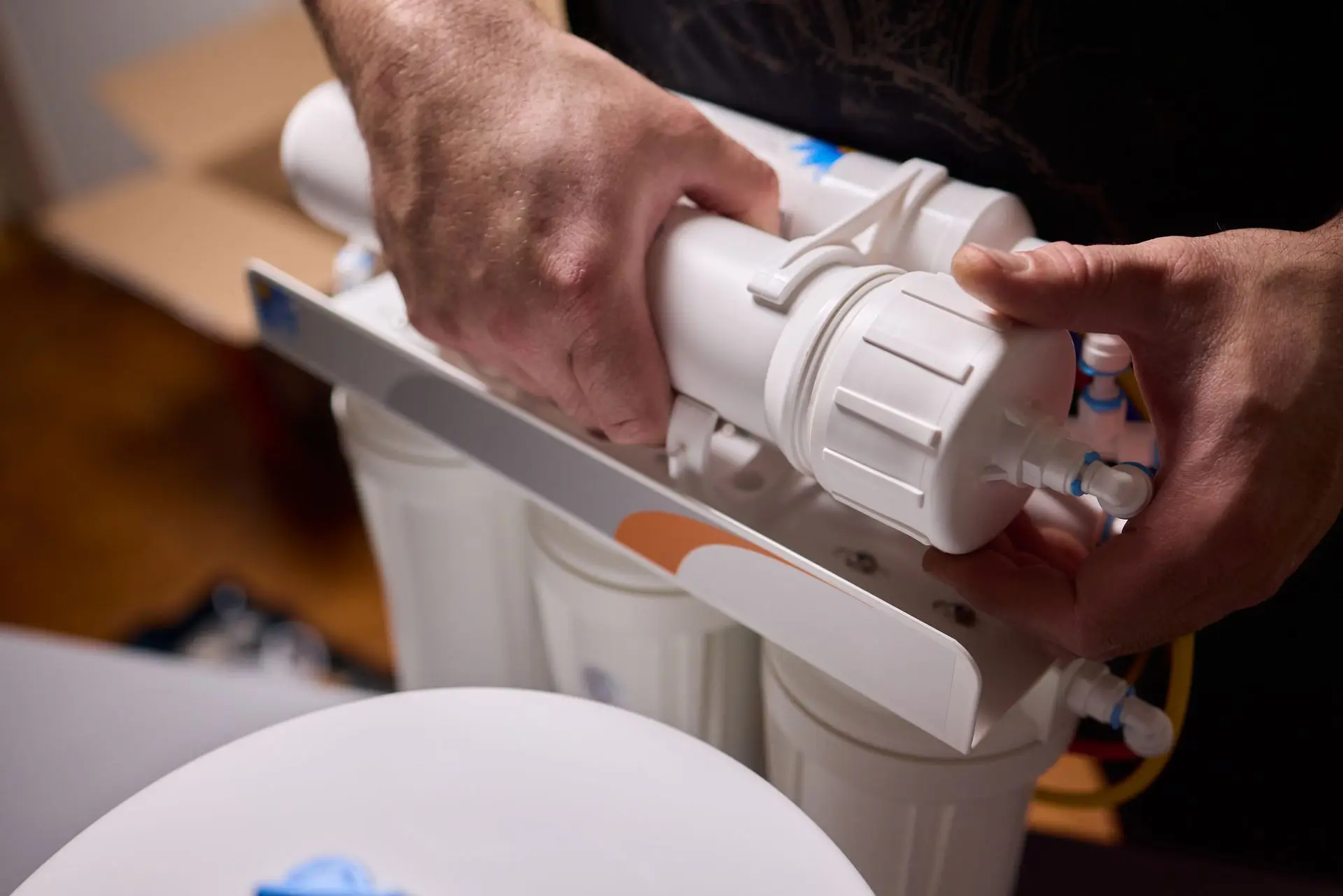
Borehole and tank water usually need more frequent changes than municipal water. Keeping a record of when each of your water filter cartridges was fitted is the easiest way to stay on schedule.
Frequently asked questions
How does a water filter work?
Most filters either strain out particles (sediment, ceramic and membrane filters), hold chemicals on a surface (activated carbon) or change the water chemistry (ion exchange and oxidation). UV disinfects rather than filters. A complete system combines several of these in sequence.
What does a water filter remove?
It depends on the type. Sediment filters remove particles, carbon removes chlorine, tastes, odours and many organic chemicals, softeners remove hardness, iron filters remove iron and manganese, and reverse osmosis removes most dissolved solids. No single cartridge removes everything, which is why a water test should come first.
Does a water filter remove bacteria?
Standard sediment and carbon filters do not, and an idle or overdue carbon filter can encourage bacterial growth. UV inactivates bacteria, viruses and protozoa, and very fine ceramic, ultrafiltration and RO membranes physically block bacteria. For borehole, rainwater or tank water that will be drunk, UV after sediment filtration is the usual final safeguard.
What are the main types of water filters?
Sediment, activated carbon (granular or block), water softeners, iron and manganese filters, reverse osmosis, UV, and ceramic or ultrafiltration. They are fitted either at the point of entry to treat the whole property or at the point of use, such as an under-sink system or filter tap.
To work out which stages your water needs, start with our overview of water filtration systems, then send us your water source, property type and area for a recommendation.