Reverse osmosis and UV do completely different jobs. Reverse osmosis (RO) pushes water through a membrane that removes dissolved solids such as salts, nitrates, fluoride and heavy metals, while a UV water purifier uses ultraviolet light to inactivate bacteria, viruses and protozoa but removes nothing from the water. In short, RO deals with what is dissolved in the water and UV deals with what is living in it, and some supplies need both.
Which one you need, if either, depends on your water source and what a test shows. For the bigger picture of how filter stages fit together, start with how water filtration systems work.
What is reverse osmosis and how does it work?
Reverse osmosis uses water pressure to force water through a semi-permeable membrane. Water molecules pass through, while most dissolved salts and metals are held back. The result is two streams: clean water (the permeate) for drinking, and reject water (the concentrate) that carries what the membrane removed to the drain.
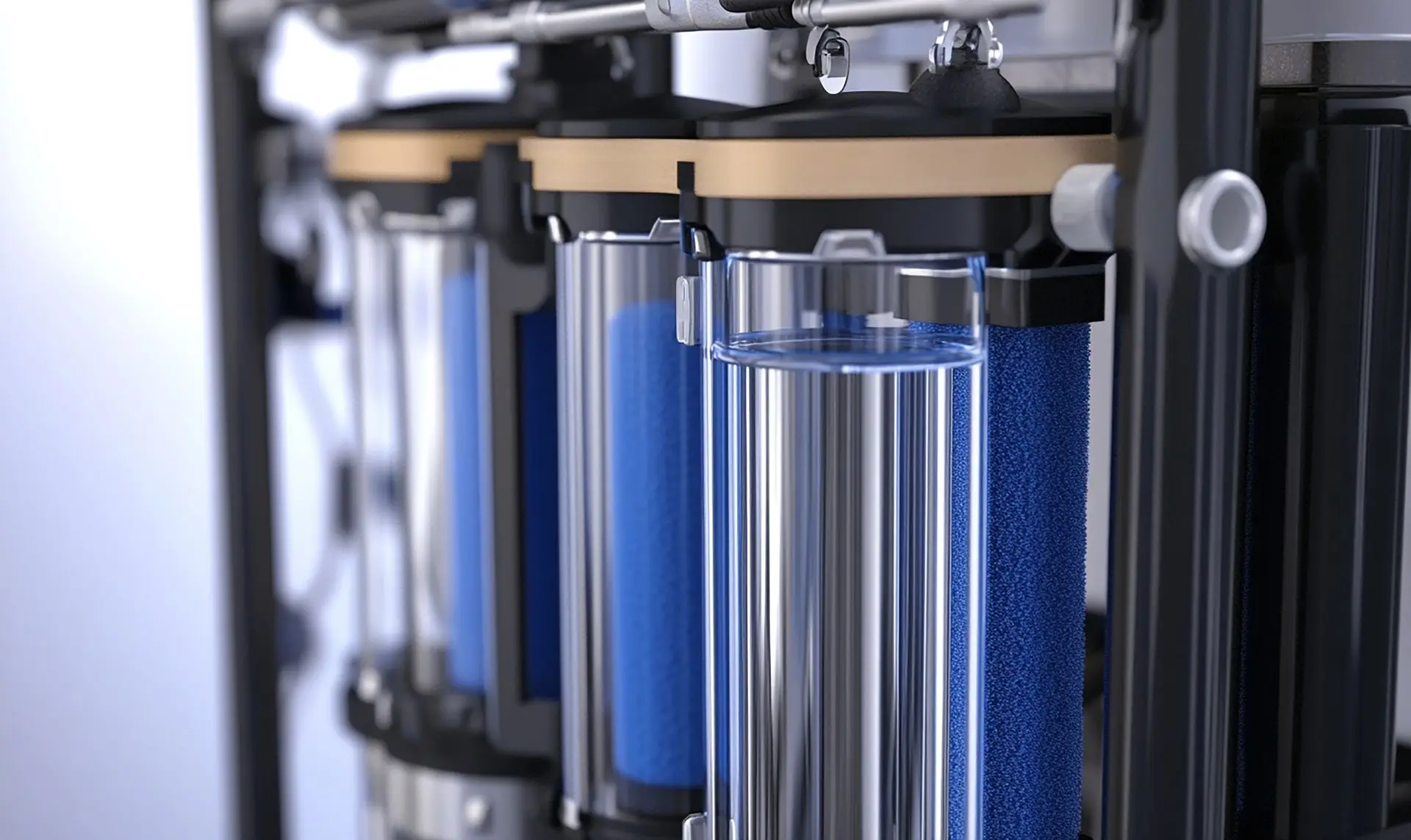
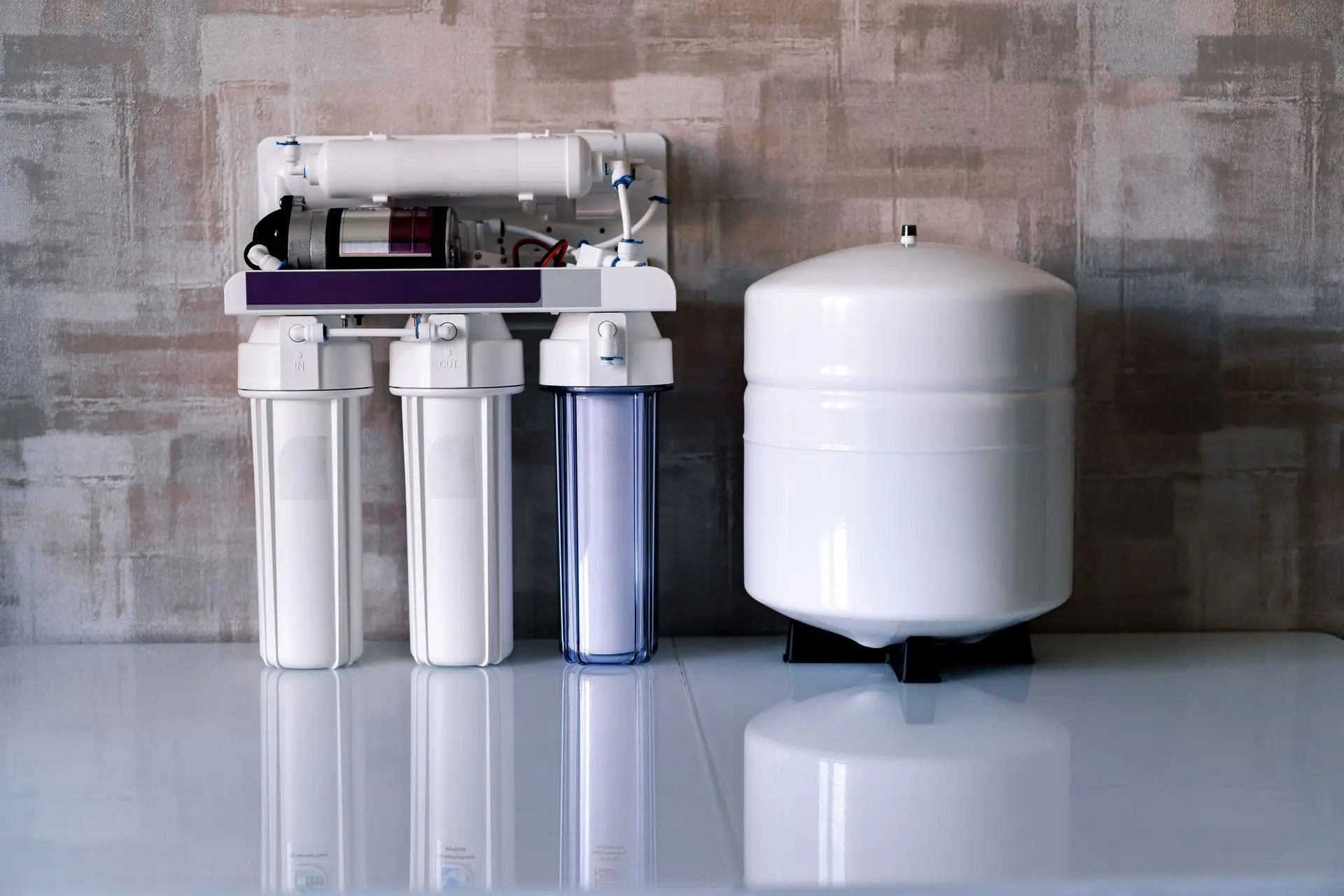
A typical household RO system sits under the kitchen sink and works in stages:
- Sediment pre-filter to catch sand, silt and rust.
- Carbon pre-filter to remove chlorine, which damages the thin-film membranes used in most household units.
- RO membrane, which does the real work on dissolved solids.
- Storage tank, because a membrane produces water slowly.
- Carbon post-filter to polish the taste, with an optional remineralisation cartridge.
Because RO is slow and sends water to drain, it is almost always fitted at one point of use, usually its own tap at the kitchen sink. Toilets, showers and washing machines gain nothing from RO water.
How does a UV water filter work?
A UV water filter is not really a filter. It is a chamber with a UV-C lamp inside a quartz sleeve. As water flows past, ultraviolet light at around 254 nanometres damages the genetic material of bacteria, viruses and protozoa so they cannot multiply or cause infection. Nothing is added or taken out, so taste and mineral content stay as they were.
UV is particularly useful against Cryptosporidium, a parasite that chlorine handles poorly at practical doses, as well as Giardia. Performance depends on the UV dose the water receives. The US standard NSF/ANSI 55 sets 40 mJ/cm² for Class A units meant to disinfect contaminated water, so ask what dose a UV steriliser delivers at your flow rate rather than looking only at lamp wattage.
UV units are sized by flow rate and usually installed where water enters the house or after a storage tank, so every tap gets treated water. A UV water filter is almost always the final stage, after the filters that clean the water up first.
What each one removes, and what it does not
| Reverse osmosis | UV disinfection | |
|---|---|---|
| Main job | Removes dissolved solids | Inactivates microorganisms |
| Bacteria, viruses, protozoa | Membrane blocks most, but household units are not sold as disinfection devices | Yes, if the water is clear and the unit is correctly sized |
| Salts and total dissolved solids (TDS) | Yes, typically more than 90% | No |
| Nitrate and fluoride | Yes, large reductions | No |
| Heavy metals such as lead | Yes, large reductions | No |
| Chlorine, taste and odour | Handled by the system's carbon stages | No |
| Iron, sediment and cloudiness | Must be removed first or they foul the membrane | Must be removed first or they block the light |
| Waste water | Yes, reject water goes to drain | None |
| Power | Basic under-sink units need none | Needed whenever water flows |
| Where it goes | One drinking-water tap | Whole house or the drinking-water line |
| Routine maintenance | Pre-filters every 6 to 12 months, membrane every 2 to 3 years | New lamp every year, sleeve kept clean |
Two points matter most. First, RO is not a substitute for disinfection. The membrane physically blocks most microorganisms, but seals, tanks and taps can still harbour bacteria, and RO manufacturers state that their units should not be used on microbiologically unsafe water without disinfection before or after the system. Second, UV does nothing about chemistry. A UV unit on a borehole with high nitrate gives you disinfected water that still has high nitrate.
What each system needs to work properly
UV needs clear water and constant power
UV light has to reach every microorganism. Cloudiness, colour and particles shield microbes from the light, while iron, manganese and hardness coat the quartz sleeve and cut its output. Manufacturer guidance is typically turbidity below 1 NTU, iron below 0.3 mg/l, manganese below 0.05 mg/l and hardness below about 120 mg/l, with a 5 micron sediment filter ahead of the unit.
UV also needs electricity whenever water flows. During load-shedding, water passes through untreated, so plan for backup power or a valve that stops the flow when the lamp is off. The lamp is replaced every year, because it keeps glowing long after its germicidal output has dropped.
RO needs pressure, a drain and clean feed water
RO relies on pressure, and manufacturer specification sheets commonly ask for at least about 280 kPa (2.8 bar, or 40 psi). Below that the membrane produces less water and works less efficiently, so gravity-fed tanks and other low-pressure supplies usually need a booster pump.
Every RO unit also produces reject water. The US Environmental Protection Agency puts typical under-sink systems at roughly 4 to 9 litres to drain for every litre of drinking water, and some newer designs are advertised at close to 1 to 1. Ask for the efficiency rating before you buy, especially on a borehole where every litre is pumped. The reject line also needs a drain point under the sink.
Chlorine, iron, manganese and hardness all shorten membrane life, so pre-filters must be changed on time and borehole iron or hardness problems need their own stages upstream.
Is reverse osmosis water healthy?
The real question is about minerals. RO removes most of the calcium and magnesium along with everything else, so reverse osmosis water is low in minerals and can taste flat. This is what the World Health Organization (WHO) has said:
- Food is the main source of calcium and magnesium. The WHO puts the typical dietary contribution at over 80% of intake, with drinking water usually supplying around 5 to 20%.
- Drinking water can still be a useful extra source for people whose diets are low in these minerals. Where public supplies are desalinated, the WHO says the water must be stabilised and that adding calcium and magnesium back should be considered.
- Some studies link magnesium or hardness in drinking water with lower cardiovascular mortality, but the WHO notes that this evidence is debated and does not prove cause and effect. It has set no minimum mineral level.
- There is no WHO health-based limit for total dissolved solids either. Its concern is taste: very low TDS can taste flat, while taste panels rate water above about 900 mg/l as poor.
In practical terms, if you eat a reasonably varied diet, the minerals RO takes out are a small part of your intake. If you prefer water with some minerals in it, a remineralisation cartridge after the membrane puts calcium and magnesium back.
Which do you need? It depends on your water source
Municipal water
Municipal water has already been disinfected, and the City of Cape Town tests more than 5 700 samples a year against SANS 241, the South African drinking water standard. For most homes on mains water, neither RO nor UV is essential. If the chlorine taste bothers you, a carbon water filter is the simpler fix and wastes no water. RO makes sense if you want very low-TDS water for drinking, coffee or ice, or simply prefer it. UV only really earns its place if you keep municipal water in a JoJo tank for long periods.
Borehole water
Borehole water is untreated, so test it before choosing anything. A laboratory test against SANS 241 shows whether the problem is microbiological (E. coli should not be detected at all), chemical (such as nitrate, fluoride or high TDS) or both. Our guide on whether borehole water is safe to drink covers what to test for.
- Bacteria present: UV as the final stage, after sediment filtration and any iron or manganese removal.
- Nitrate, fluoride or salty water above the limits: RO at the kitchen tap for drinking and cooking. Nitrate is a particular concern for bottle-fed infants, so speak to a doctor if a test shows high nitrate and there is a baby in the house.
- Iron, manganese or staining: neither RO nor UV is the fix. These need their own removal stage first, or they foul the UV sleeve and the RO membrane.
- Bacteria and dissolved problems together: UV for the whole house, plus RO for drinking water.
The order matters as much as the equipment, which is why borehole water filtration is specified from the test results rather than from a standard kit.
Rainwater and tank water
Rainwater is naturally very low in dissolved solids, so RO rarely adds much. The risk is microbiological: droppings from birds and small animals, insects and debris washed off the roof. That makes UV the key stage, but only with good prefiltration in front of it, because tank water often carries fine sediment and colour that shield microbes from the light. A first-flush diverter and clean gutters help too. The rainwater filtration guide covers the full setup.
Combined RO and UV systems
Some sites genuinely need both, and there are two common layouts:
- Whole-house UV plus RO at the kitchen tap. This suits boreholes and rainwater systems with both microbiological and dissolved problems. Every tap gets disinfected water, and drinking water also has its dissolved solids removed.
- An under-sink RO unit with a small UV stage built in. The UV lamp often sits after the storage tank, just before the tap, so water that has stood in the tank is disinfected on its way out. This protects the drinking tap only.
A combined system is not a shortcut around testing. It still needs the right stages in front of it, and if your water has no dissolved-solids problem, RO only adds waste water and maintenance.
Frequently asked questions
Is RO or UV better?
Neither, because they solve different problems. RO deals with dissolved contaminants such as salts, nitrate, fluoride and metals, and UV deals with bacteria, viruses and protozoa. A water test tells you which problem you have.
Does reverse osmosis remove bacteria?
The membrane blocks most bacteria, viruses and protozoa, but household RO units are not designed as disinfection devices. If bacteria are the concern, add UV.
Does a UV water purifier remove chlorine or bad taste?
No. UV removes nothing from the water, so chlorine, taste and odour need a carbon stage.
Does reverse osmosis remove fluoride?
Yes. Many household RO systems are independently certified to reduce fluoride, along with nitrate and lead, which makes RO the usual answer when a borehole test shows fluoride above the limit.
If you already know your water needs its dissolved solids removed, see how we specify and fit reverse osmosis systems. If you are not sure whether you need RO, UV, both or neither, send us your water source, property type and area with any test results, and we will work out what your water actually needs.